2,000 Rayon Cushion Covers Reworked in Two Days
The Brief: Red Rayon Cushion Covers with Maroon Piping
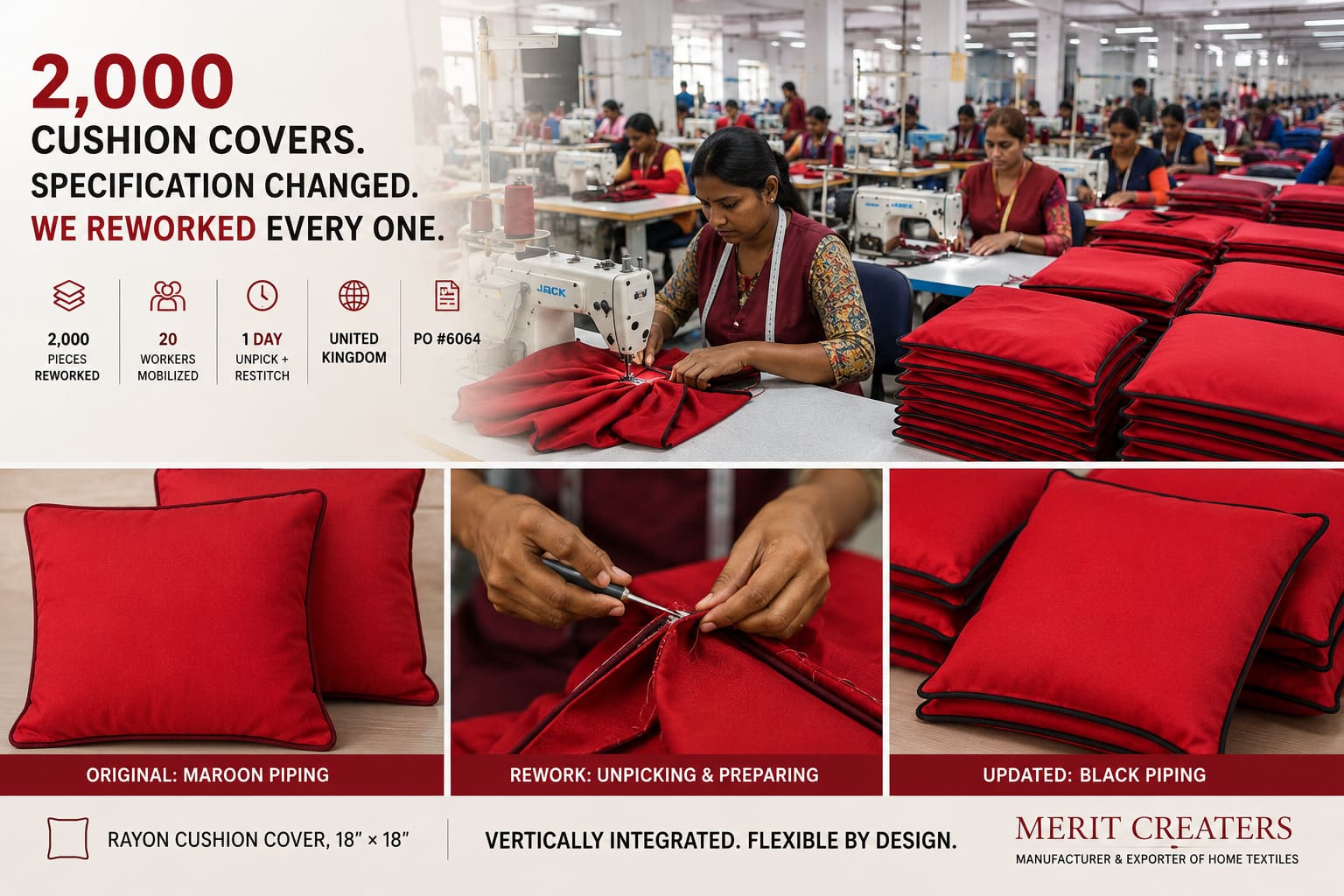
A client from the United Kingdom ordered 2,000 rayon cushion covers (18" × 18") to be manufactured with red fabric on both front and back, paired with maroon piping along the seams. The buyer's product team approved a physical sample (sent via courier) confirming the color match, fabric weight, and construction quality. With approval locked in, production commenced under Purchase Order #6064.
The Curveball: A Change Request Mid-Production
Two thousand pieces were manufactured and fully completed: seams stitched, piping attached, quality inspected. Then an email arrived: the buyer's end customer had requested a design change. The maroon piping was no longer acceptable. They wanted black piping instead.
In outsourced supply chains, this email typically triggers a negotiation. The factory might refuse the change (citing production costs already sunk), offer to absorb partial costs, or propose a compromise that satisfies no one. Lead times extend. Relationships strain. The buyer absorbs the delay or accepts a product that misses their market window.
Merit's vertically integrated operation changed the equation. Because unpicking, re-piping, and re-stitching were all happening under one roof with one team, the decision was structural, not political: What does the buyer need? When do they need it? Can we do it?
Our Response: 20 Workers, One Day to Unpick
(Names reflect team roles, not individually verified testimonials.)
The production floor mobilized immediately. Rajkumar, our floor supervisor, assessed the rework scope: 2,000 cushion covers, each requiring the front and back panels to be unpicked from their stitched seams, the old maroon piping removed, new black piping sewn in, and the panels re-stitched. This was not a design iteration; it was a full deconstruction and reconstruction of finished goods.
He deployed 20 stitching-line workers to the unpicking task. Using precision thread-cutting tools and careful hand work to avoid damage to the rayon fabric (known for its drape but also its vulnerability to snags), the team systematically separated all 2,000 pieces into front panels, back panels, and piping-free seam edges. One day. Complete.
Overnight, the supply team prepared black piping fabric to specifications matching the original maroon runs. The next morning, re-stitching commenced. The same workers, now re-piping and re-seaming the panels, completed the re-assembly of all 2,000 units. Because Merit's in-house embroidery and stitching team had sewn the originals, they knew the machine tensions, thread weights, and stitch counts that delivered consistency. No external vendor communication. No specification ambiguity. One team, one standard.
Final Approval: Quality Check and Buyer Verification
Once re-stitching was complete, all 2,000 units moved through final quality inspection. Seam strength, piping alignment, color match of the new black piping against the red fabric, overall finish—each unit was visually inspected to the standard Merit applies across all production runs. Approved and packed for shipment.
The buyer's logistics representative attended the final verification, inspected the reworked lot on-site, and confirmed buyer approval. The order was shipped within days of the color-change request. Feedback relayed through the buyer's side acknowledged the pace and execution quality. This response would have been impossible in a fragmented supply chain.
Why This Matters for Your Business
Change requests in textile manufacturing are inevitable. Markets shift, end customers revise specs, retail partners demand tweaks, or a buyer's own quality team identifies an improvement mid-order. How a manufacturer responds determines whether a change costs you delays or just capital.
Outsourced supply chains face coordination tax: the factory talks to a trading company, who talks to the dyer, who talks to the printer, who talks to the stitcher. Each conversation has a lag. Each vendor has an incentive to push back (sunk costs, setup minimums, contract terms). You're caught in the middle.
Vertical integration eliminates this friction. When you work with a manufacturer that controls design, weaving, dyeing, printing, cutting, stitching, and quality inspection in-house, a change request is a production task, not a supply-chain negotiation. The rework happens at speed. Time and labor are the only costs, and the manufacturer can optimize both because the facility is under one roof, managed by one team.
This is why Merit's low minimum order quantities (200 units for most products) and flexible customization options are structural outcomes of owning the entire process, not just marketing advantages. You can test designs with small batches, request color or material changes without penalty, and scale based on real market feedback. For retailers, private-label brands, and e-commerce companies, this flexibility is competitive advantage.
If you're sourcing rayon or other specialty fabrics with custom construction—piping, embroidery, printing, or non-standard colorways—the manufacturer's ownership of its supply chain directly affects your time-to-market and your ability to respond to market changes without economic pain.
Ready to Source with Us?